Architecture
Evarness is a harness: a small set of primitives around a model loop. The loop and the governance kernel are the core; everything else is a plugin on the SDK.
The diagram is a conceptual overview, not a code map. The turn it shows is the pipeline in
src/evarness/runtime/turn/, described stage by stage below.
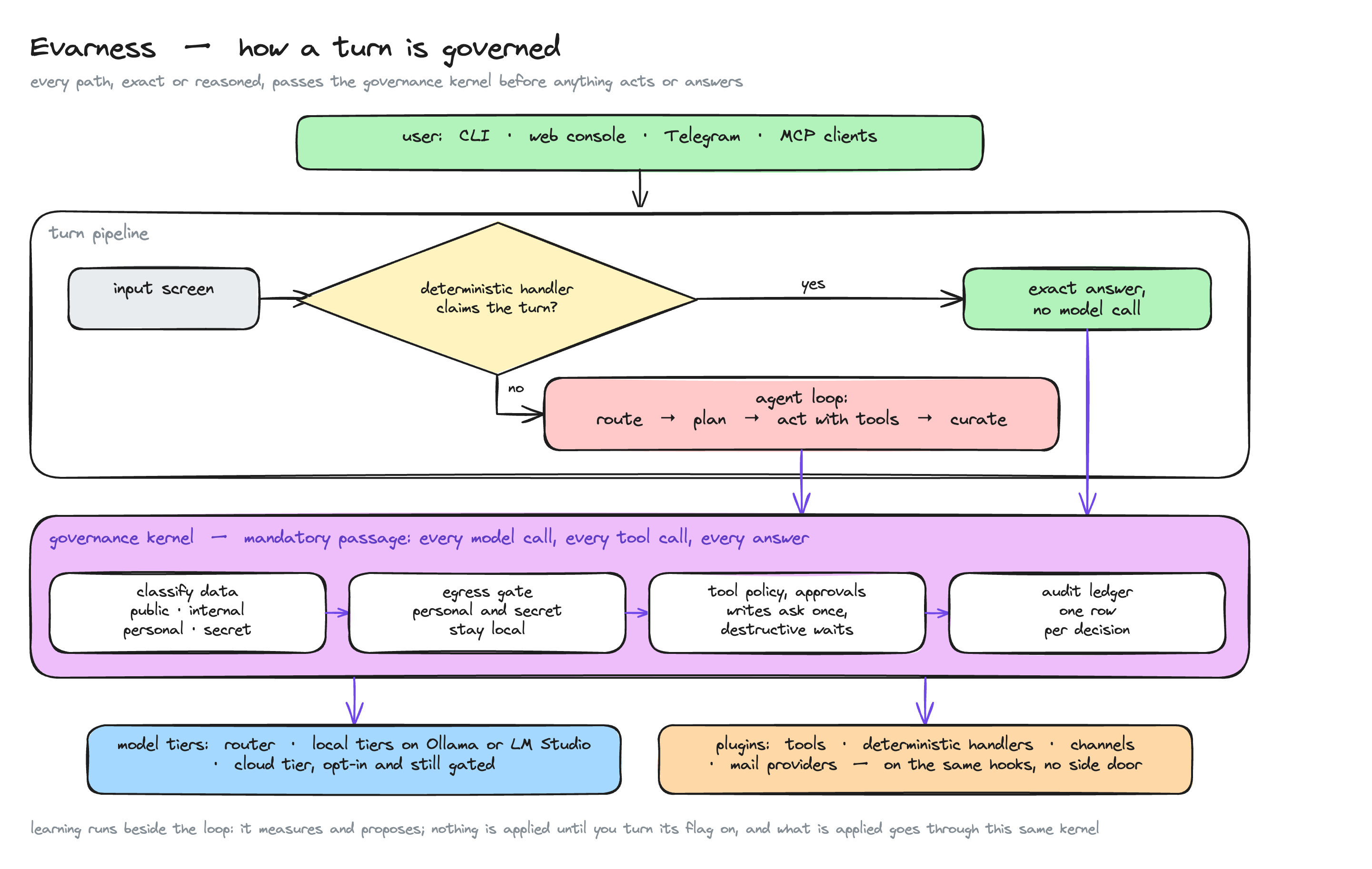
  CLI · web console · Telegram · MCP clients
                    │
              Evarness API (:8003)
                    │
  ┌──────────────── turn pipeline ────────────────┐
  │ input screen → deterministic handlers ───┐    │
  │      │ (no handler claimed the turn)     │    │
  │      ▼                                   ▼    │
  │ IntentRouter → TaskPlanner         model-free │
  │ → ReAct loop → AgentExecutor         guards   │
  │ → curator (model-free checks + judges)   │    │
  │      ▼                                   ▼    │
  │      record: session log + audit → answer     │
  └───────────────────────────────────────────────┘
        │ every model call, every tool call
        ▼
  governance kernel: classify · egress gate · vault · tool policy
                     approvals · evaluator · audit ledger
        │
  tiers: router model · local tiers (Ollama, LM Studio) · opt-in cloud tier
The turn
Every message is one turn through one pipeline (src/evarness/runtime/turn/), the
same for the REPL, the API, streaming and every channel:
- Input screen. The message is classified and screened before anything acts on it.
- Deterministic handlers. Plugins' intercepts see the message in order; the first that claims it answers with no model (deterministic handlers).
- The agentic loop, when no handler claimed the turn: the
IntentRouterclassifies the intent and picks a model tier; theTaskPlannersplits a compound request into tasks only when they need different agents; the ReAct loop alternates thought, tool call and observation until it has an answer or hits its step or cost cap; theAgentExecutorruns the agent the intent names. - Curate or guard. A generated answer goes through the curator: the model-free checks (credentials, identity secrets, internal details) and the model-based judges you turn on (faithfulness, grounding, output safety). A deterministic handler's answer goes through the same model-free checks. Each check writes an audit row.
- Record. The answer goes into the session log through one recording path, however it was produced.
Model tiers
config/llm_tiers.yaml names the models: a small router model, local tiers for most
work, and an optional cloud tier. Routing follows the intent and the data: personal or
secret data never leaves the local tiers, whatever the intent asks for. The cloud tier
is off until you configure it, and even then it sees only data the egress gate lets
out (governance).
The tiers are sized to the machine by a model set (config/doctor.yaml). A set names
the RAM it fits, the models to pull and a sparse override of the tiers. evarness doctor
picks the largest set the host fits, standard (the shipped tiers, 16 GB) or lite
(8 GB: one 4B model, the email judge's, serves tier 2 as well), and --fix pulls that
set's models and saves its overrides as settings, the same tier edits the console
makes, so an upgrade keeps them and you can still change one tier afterwards. Separate
from that install-time sizing, the resource governor (opt-in, EVARNESS_ADAPTIVE_TIERS)
downshifts a turn to tier 1 when the host is under memory or thermal pressure.
Services
| Service | Port | Module |
|---|---|---|
| Evarness API: chat, streaming chat, the MCP server, the web console and its data | 8003 | evarness.server.harness_api.main:app |
| Governor: the HTTP front of the governance kernel | 8080 | evarness.server.governor.main:app |
| Evaluator (out-of-process, optional) | 8090 | evarness.server.evaluator.main:app |
| Channel gateway (Telegram) | 8006 | evarness.server.channel_gateway.main:app |
The CLI commands in the quickstart run in-process and need none of them; the scheduled jobs and the web console run in the Evarness API.
Background work
Heartbeats are scheduled jobs (the email sweep and judge are two). They run on one scheduler inside the Evarness API, under the same governance as a turn, and report each run to System Health. An event bus carries work that finishes outside a turn to whoever subscribed, and channels deliver the results.
Memory
Evarness remembers in memris, a graph of claims with provenance (src/memris/): what
was said, by whom, from which source, with what confidence. Capture gates keep
implausible or ungrounded facts out of the store, a recall filter keeps low-confidence
ones out of the prompt, and every change is reversible.
Where the code is
| Path | What lives there |
|---|---|
src/evarness/runtime/ |
The composition root, the turn pipeline, the plugin host. |
src/evarness/agent/ |
The agentic core: router, planner, ReAct loop, executor, curator. |
src/evarness/kernel/governance/ |
The governance kernel. |
src/evarness/sdk/ |
The plugin SDK: the stable surface plugins import. |
src/evarness/plugins_builtin/ |
The reference plugins: system, channels, research, code execution. |
src/evarness_personal/ |
The email assistant: the mail record and the email plugins. |
src/evarness/server/ |
The four HTTP services. |
webui/ |
The web console (React). The released package carries a production build. |